

An (Expanded) Checklist of Therapy Harm With Diagrams
While each experience in therapy or clinical care is unique, there are some common themes in harmful or challenging experiences in therapy. A few years ago, when I was in the middle of a very confusing therapy with blurred boundaries, I came across a couple of checklists on therapy abuse or unethical conduct in therapy. While I don’t view my previous therapist as abusive, the resources were still a great help to understanding that the therapeutic relationship had become very unhealthy.
The goal of this article is to create a set of items that often occur in therapy harm, using an expanded definition of harm — i.e. any situation that led to confusion, distress, or a negative impact for the patient (with therapy abuse or unethical behaviour then becoming a specific subset of therapy harm)— as well as accompanying visual diagrams. While many items on the list are always unethical, such as a clinician dating a patient, a few items might be okay or even beneficial in specific circumstances, but are included because they have a high risk of leading to harm or confusion in the patient. Still other items may be due to factors outside of a clinician’s control (for example, cases where a clinician sadly passes away unexpectedly), but nonetheless may end up being deeply distressing for the patient.
(In short, this tool is meant more as a supportive resource for reflection after harmful or confusing experiences in therapy, rather than an ethics tool.)
All of the below are very much in development, and any feedback or suggestions for items that are overlooked currently are very welcome!
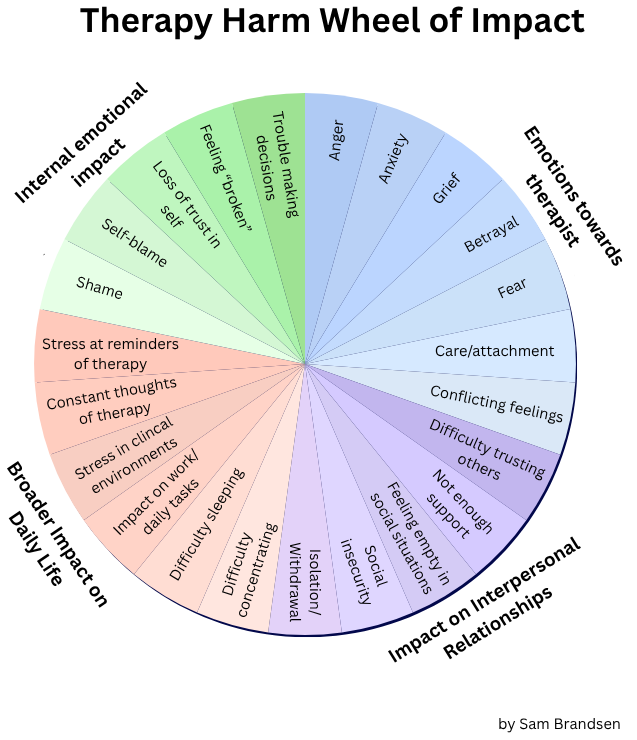
The visual version of the tool is below, as well as a “Wheel of Impact” that aims to help patients reflect on how their experience in therapy impacted them:

As well as a “Wheel of Impact” (below)
Finally, below is a longer, written list of items that can sometimes be a part of therapy harm:
Dual roles or overlap:
My therapist and I have overlapping social circles
I have involvement in my therapist’s practice beyond being a patient (e.g. occasionally volunteer or help out with their practice)
I sometimes do or receive professional favours for my therapist
I go to the same gym/religious organisation/social group as therapist
My therapist is also seeing someone I am close to (partner, family member, etc.)
I have met one or more of my therapist’s family members or close friends
I saw my therapist outside of session or in another setting by coincidence, and it has influenced how I see them as a therapist
Other
Situational harm (e.g. crises in therapist’s life):
My therapist seems burnt out
My therapist frequently cancels sessions due to external situations in their life
My therapist begins disclosing about stressors in their life during session
My therapist seems more distracted, detached, or unpredictable after events in their life
My therapist hasn’t specifically disclosed extenuating circumstances or stressors, but they seem to be much more exhausted, burnt out, or stressed than when I first met them
Therapy is ending abruptly due to external factors
I find it hard not to worry about my therapist
My therapist is seriously ill
My therapist passed away
Other
Identity related harm:
I have experienced stigma, discrimination, or microaggressions in therapy
I have to spend a lot of time educating my therapist about their identity
My therapist seems to “not really get” identity-related experiences
My therapist shares an identity with me, but at times I feel like they are projecting their own experience onto me or sharing in more detail than is comfortable
My therapist either overlooks my identity or overly focuses on it
My therapist seems to doubt my identities at times (e.g. neurodivergence, gender identity)
My therapist seems to think my identities are unrelated to my mental health
My therapist seems to overly attribute my mental health to my identities, even when I don’t feel they are related
My therapist doesn’t want to talk about/share their views on racism, ableism, LGBTQ+ discrimination, classism, etc.
My therapist doesn’t seem to have much experience related to one or more of my identities
Other
Contact outside session/digital boundaries:
My therapist communicates with me via social media
Contact between sessions feels confusing (e.g. lots of texts, emojis, etc.)
My therapist has frequent vacations/long gaps where they are completely unavailable
My therapist’s contact policies seem unpredictable or quickly changing
My therapist has given me their personal phone number or email
My therapist mentioned searching me online
I sometimes find the gaps in between session or absence of contact between sessions to be difficult
I feel very uncertain about when it is okay for me to reach out to my therapist in between session
Other
General:
Therapy feels too rigid or too flexible
My therapist is often late for sessions
The approach/modality just doesn’t seem that helpful to me
It feels like there are frequent misunderstandings in therapy
Many of the suggestions in therapy don’t seem practical/applicable to my life
I feel like my therapist is detached or doesn’t like me
My therapist sometimes seems distracted in session
My therapist talks about themselves more or less than I am comfortable with
Therapy doesn’t feel collaborative (e.g. my therapist writes goals that don’t align with my actual interests)
My therapist’s main focus or specialisation is not related to areas I am seeking care (e.g. my therapist specializes in depression and PTSD, but I am seeking care for an eating disorder)
“Special treatment”, friendship, physical touch:
My therapist says I am their favorite patient/am special to them/etc.
My therapist has mentioned wishing they could have met me in another role (friends, partner, family member)
Sessions have become increasingly warm or friendly
My therapist has begun giving me longer and longer sessions
My therapist often makes exceptions for me
My therapist gives me gifts
My therapist hugs me or otherwise touches me
Sometimes it seems that my therapist likes me so much, they have a hard time understanding my role in situations
My therapist offered to become friends
I have seen my therapist outside of session (e.g. for coffee, visiting them at their house, etc.)
I have been invited to my therapist’s house
My therapist has visited me at my house
“Cold treatment”:
It feels like my therapist is becoming less and less warm with time
My therapist’s reactions often feel dismissive
I feel like my therapist often blames me for things going wrong in my life
My therapist seems more focused on changing “negative” parts of me than supporting me
My therapist has snapped at me or been irritable towards me
My therapist has described me as difficult, overly dramatic, etc.
My therapist is hostile towards me or seems to enjoy my pain
Financial harm:
My therapist has overcharged me for session
My therapist changes their fees on short notice
I have to end therapy due to financial challenges
I feel overly indebted to my therapist because they are seeing me for free/low cost
My therapist encourages me to see them more than I can afford
Confidentiality:
My therapist talks about other patients with me in detail
My therapist shares names or identifying details about other patients with me
My therapist has shared information about me with others
My therapist acknowledged me outside of session in a way that was uncomfortable
My therapist writes about their practice or posts about it on social media in a way that I feel uncomfortable with, even if they aren’t specifically identifying me or any other patients
I have been able to identify myself in my therapist’s writings/posts/presentations
Isolation, retaliation, and gaslighting:
My therapist puts pressure on me (either directly or indirectly) to keep session confidential
My therapist says that others wouldn’t understand our therapy relationship
My therapist discourages me from finding another therapist
My therapist has become angry with me or retaliated against me when I bring up my concerns
My therapist questions my memory of therapy harm events/says I am misremembering
I feel like my therapist has weaponised diagnoses against me
My therapist has fabricated or changed clinical notes
My therapist becomes upset with “negative” feedback or blames it purely on transference
Romantic or sexual:
My therapist has engaged in any form of sexual touch or sexual act with me
My therapist has made sexual comments or innuendos to me
My therapist has expressed their attraction to me
My therapist makes inappropriate or sexualised comments on my appearance
My therapist compliments my appearance in a way that feels uncomfortable to me
Therapist has dated me or asked to date me
My therapist frequently asks me irrelevant/inappropriate sexual questions in session
My therapist asks me questions about my dating and/or sex life that make me uncomfortable, even if I am not sure if they are inappropriate or not
My therapist shares information about their dating or sex life in detail or in a way that feels uncomfortable or confusing
When I asked my therapist about the possibility of dating or a physical relationship with them, they seemed open to it or did not clearly state boundaries (e.g. “I can’t date you while you are a patient, but maybe afterwards/after a few year’s gap”)
